beyond what point must an object be squeezed for it to become a black hole answer
Black Holes
(Credit: NASA'south Goddard Space Flight Center/J. Schnittman, J. Krolik (JHU) and South. Noble (RIT))
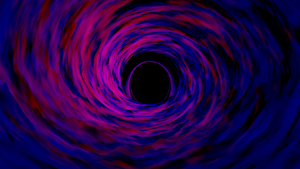
The simplest definition of a black hole is an object that is so dumbo that non fifty-fifty light can escape its surface. But how does that happen?
The concept of a blackness hole tin be understood by thinking about how fast something needs to motion to escape the gravity of another object – this is chosen the escape velocity. Formally, escape velocity is the speed an object must reach to "break free" of the gravitational attraction of another body.
There are 2 things that touch the escape velocity – the mass of object and the altitude to the heart of that object. For example, a rocket must advance to eleven.two km/s in club to escape Earth'south gravity. If, instead, that rocket was on a planet with the same mass equally Earth just half the diameter, the escape velocity would be 15.8 km/southward. Fifty-fifty though the mass is the same, the escape velocity is greater, considering the object is smaller (and more dense).
What if we made the size of the object fifty-fifty smaller? If we squished the Globe's mass into a sphere with a radius of 9 mm, the escape velocity would be the speed of light. Simply a wee-flake smaller, and the escape velocity is greater than the speed of light. Just the speed of light is the catholic speed limit, then it would be impossible to escape that tiny sphere, if you got shut enough.
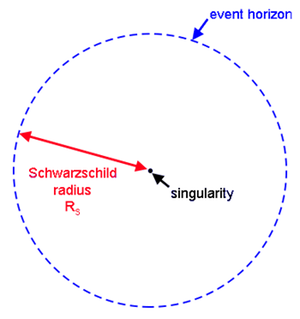
The radius at which a mass has an escape velocity equal to the speed of low-cal is called the Schwarzschild radius. Any object that is smaller than its Schwarzschild radius is a black hole – in other words, annihilation with an escape velocity greater than the speed of light is a black hole. For something the mass of our sun would demand to be squeezed into a book with a radius of near 3 km.
(Credit: NASA'southward Imagine the Universe)
Structure of a black hole
There are two basic parts to a black pigsty: the singularity and the event horizon.
The event horizon is the "point of no return" around the blackness hole. Information technology is not a physical surface, just a sphere surrounding the black hole that marks where the escape velocity is equal to the speed of lite. Its radius is the Schwarzschild radius mentioned earlier.
Ane thing about the event horizon: in one case matter is inside information technology, that thing will autumn to the center. With such strong gravity, the matter squishes to just a point – a tiny, tiny volume with a crazy-large density. That point is called the singularity. It is vanishingly minor, and so information technology has essentially an infinite density. It'southward likely that the laws of physics break downward at the singularity. Scientists are actively engaged in enquiry to ameliorate understand what happens at these singularities, also every bit how to develop a total theory that better describes what happens at the heart of a black hole.
Seeing the unseen
If calorie-free tin can't escape a black hole, how tin we encounter black holes?
Astronomers don't exactly see blackness holes directly. Instead, astronomers observe the presence of a black hole by its effect on its surroundings. A black hole, by itself out in the center of our milky way would be very difficult to observe.
Imagine you arrive dwelling house one night to find the kitchen a mess. You know that it was make clean when you left, only now at that place are dirty dishes in the sink and crumbs strewn about the counter. From the evidence, you know someone used the kitchen while you were out – in fact, you tin can even say that they fabricated a sandwich and chips because of the types of crumbs you see on the counter. You might fifty-fifty be able to identify who in your household was in the kitchen based on what kind of chips they had or what they put on their sandwich. You never saw that person in the kitchen, but their consequence on the kitchen was evident.
Studying black holes relies heavily on indirect detection. Astronomers cannot detect black holes direct, but see behaviors in other objects that can just be explained by the presence of a very large and dense object nearby. The effects tin can include materials getting pulled into the blackness hole, accretion disks forming effectually the blackness pigsty, or stars orbiting a massive but unseen object.
This artist'south rendering illustrates new findings about a star shredded by a black hole. When a star wanders too close to a black pigsty, intense tidal forces rip the star apart.
Credit: NASA GSFC/CI Lab
Types of blackness holes
Traditionally, astronomers have talked about two basic classes of black hole – those with masses about v-20 times that of the lord's day, which are called stellar-mass black holes, and those with masses millions to billions times that of the sun, which are chosen supermassive black holes. What about the gap between stellar mass and supermassive black holes? For a long time astronomers had proposed a third class, called intermediate mass black holes, but it was just in the past decade or so that they have started finding possible evidence of this class of black hole.
Stellar-mass black holes are formed when a massive star runs out of fuel and collapses. They are found scattered throughout the galaxy, in the aforementioned places where we detect stars, since they began their lives as stars. Some stellar-mass black holes started their lives as role of a binary star system, and the way the blackness hole affects its companion and their surroundings can be a clue to astronomers about their presence.
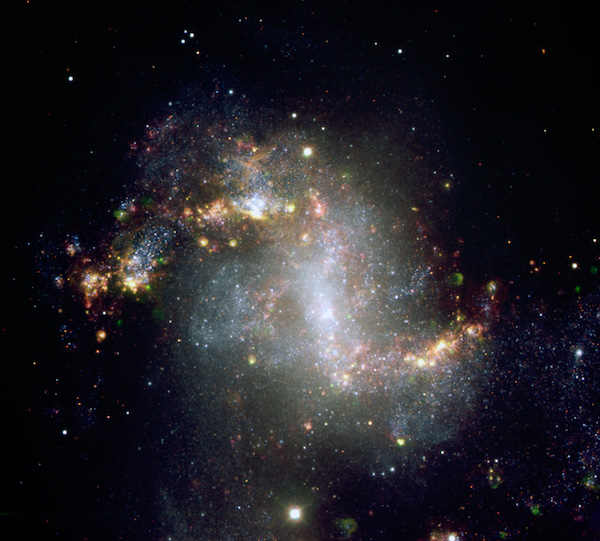
Supermassive black holes are establish at the center of nearly every large galaxy. Exactly how supermassive black holes form is an active area of research for astronomers. Recent studies have shown that the size of the black hole is correlated with the size of the galaxy, so that the there must be some connection between the formation of the black hole and the galaxy.
With only a few candidate intermediate black holes, astronomers are just beginning to study them in any detail. These studies are complicated past the fact that many of the objects that initially looked like strong intermediate black hole candidates can be explained in other ways. For instance, there is a class of object chosen ultraluminous X-ray sources (ULXs). These objects emit more Ten-ray light than known stellar processes. Ane model postulated that ULXs harbor an intermediate black pigsty; however, further study of these objects has favored alternate models for most of them. Stay tuned as astronomers piece of work to unravel the mysteries of these elusive objects.
(Credit: ESO)
Updated: Nov 2016
Additional Links
- Quiz me virtually this topic!
- Cool fact almost this topic!
- Try This !
- FAQs on Black Holes
- Give me additional resources!
Related Topics
- Supernovae
- Ten-ray Binaries
- Active Galaxies
- The Hole Story? New Type of Black Pigsty Poses Challenges
- Chandra Discovers the History of Black Pigsty 10-ray Jets
- Scientists Observe Light Fighting to Escape Black Hole's Pull
- Black Holes May Take Space For a Spin
- ASD Podcast Featuring X-rays and Black Holes
For Educators
- NCTM & NSES Standards
- Black Holes Booklet
- The Life Cycles of Stars Booklet
- Show me related lesson plans
Source: https://imagine.gsfc.nasa.gov/science/objects/black_holes1.html
0 Response to "beyond what point must an object be squeezed for it to become a black hole answer"
Postar um comentário